In the spring of 1999, I was working as the news editor at a weekly gardening magazine, when a box of new plant samples was delivered to my desk. Inside were three perennials in two-litre pots that had been sent by Blooms of Bressingham for me trial prior to their official launch. I cannot remember the identities of two of them, but the other was a specimen with a label bearing the name Geranium Rozanne.
At the time, I was living in a third-floor flat on the South Coast without access to any kind of outdoor space. I could have given the plants to another member of staff to evaluate, but I was intrigued to see how they would perform. One weekend, I drove up to Nottinghamshire and planted them in my mum and dad’s garden. Twenty-six years later and that promotional freebie is still going strong.
Floral performance
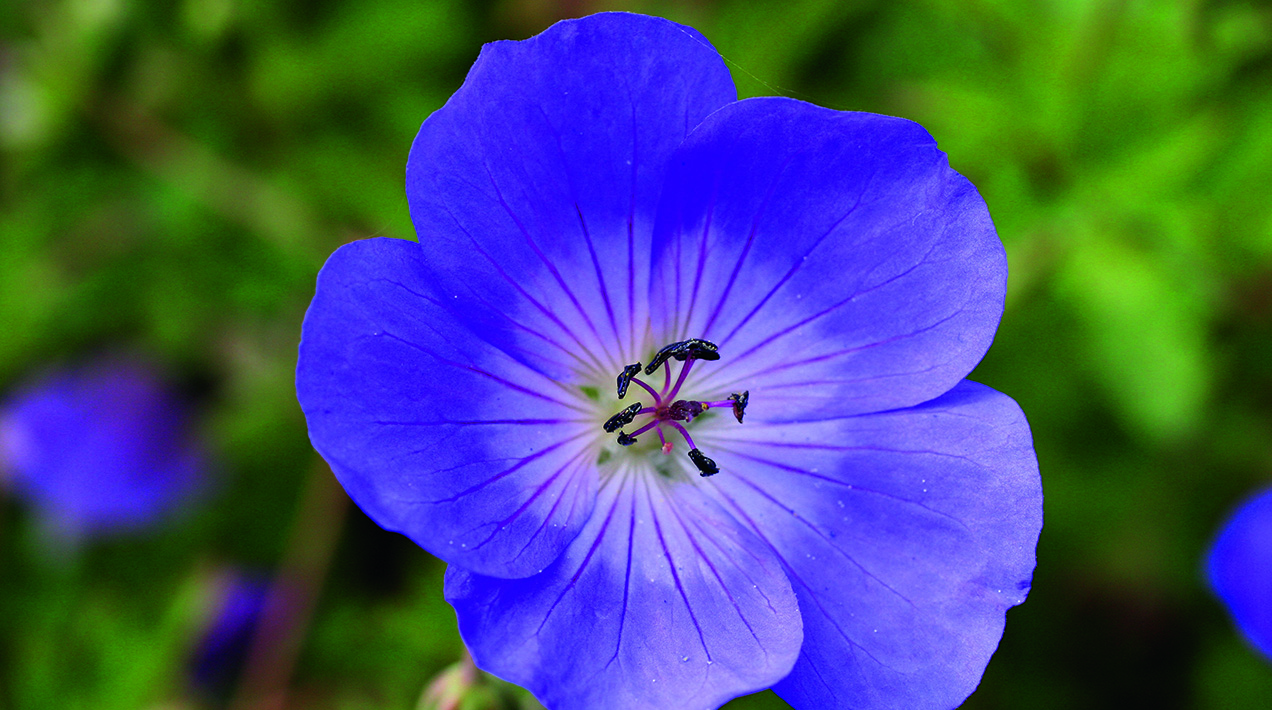
Forming a mound of attractive lobed leaves, 60cm tall by 80cm wide, this plant is renowned for its floral performance, with many pundits claiming it is the longest flowering of all hardy geraniums. Often making their debut in May, blooms are produced in great profusion until October. The saucer-shaped, lavender-blue flowers, up to 5cm across, are adorned with white eyes and distinctive reddish veins.
In the garden, this perennial is often seen softening the edges of paths, patios and other areas of hard landscaping, planted en masse as ground cover or spilling over the edges of beds and borders. Part of its appeal is that it is easy going, does not need dead-heading, is happy in sun or partial shade and that it will thrive in just about every type of soil, apart from ground that is very dry or vulnerable to waterlogging.
For a plant with superstar status today, G. Rozanne had a humble start in life. A cross between the early-flowering G. himalayense and the free-flowering G. wallichianum ‘Buxton’s Variety’, it was discovered in the late 1980s as a chance seedling growing in the garden owned by the late Donald and Rozanne Waterer in the village of Kilve in Somerset.
The couple were both keen gardeners — Donald also ran the legendary Knaphill Nursery in Woking before retiring in 1976 — so realised the seedling was different to other hardy geraniums. To see whether a leading nursery would be interested in trialling and introducing it, they wrote to Adrian Bloom, the creator of Norfolk-based Foggy Bottom Garden and then boss of Blooms of Bressingham Nursery.
Dated 14 October 1992, the letter was not accompanied by any photos, but it included a detailed description: “The plant is now 3-4ft in diameter and 21in in height. Today it is magnificently in flower with about 50 large upward-looking flowers 2in in diameter, blue with pale centres.” Bloom recalls: “That was enough for me to suggest they had found something special.”
In early 1993, both parties reached an agreement and the couple handed over their sole specimen to Bloom, who planted it near to his house, where he could keep it under a watchful eye. “Even though the plant was exceptional, there were a lot of hardy geraniums being introduced around that time, so I knew close observation of the plant was paramount,” he explains.
Impressive performance
Bloom was impressed by how it performed and started to look at ways of bulking up numbers for sale. Hardy geraniums are typically increased by division, but the nursery found young plants created this way were not good enough for supplying to garden centres. As an alternative, it sent material to a micropropagation facility to increase stock via tissue culture.
Seven years after planting it in his garden, the geranium was named Rozanne and launched to great acclaim at the RHS Chelsea Flower Show in 2000, where a swathe of plants spilled out of a well on the Blooms exhibit. At the time, I was working on a gardening website, where a report on Chelsea new plant launches stated: “The one that’s making most noise this year is G. Rozanne.”
For many people, it would have been the first time they would have heard about Rozanne Waterer, but it is not the only plant that bears her name. There is a double white, pink-tinged Rhododendron called ‘Rozanne Waterer’ and Erica cinerea ‘Rozanne Waterer’, a heather from 1962 with ruby-coloured flowers. Both were introduced by Knaphill Nursery.
Building up to launch, Blooms had 10,000 units ready to supply to garden centres and was looking to increase that number to 20,000 per year with all sales coming from its nursery. Protected by Plant Breeders’ Rights in Europe and a US plant patent, Rozanne was then licensed to other growers and by 2020 an estimated 20 million specimens had been sold around the world.
Since its launch, Rozanne has won multiple accolades. It holds an RHS Award of Garden Merit and was named Perennial of the Year 2008 by the Perennial Plant Association in the USA. In 2013, it went head-to-head against Rosa Peace, Erysimum ‘Bowles’s Mauve’ and a host of other well-known plants in an RHS competition to celebrate the 100th birthday of the Chelsea Flower Show. Representing the decade 1993 to 2002, Rozanne won the public vote to be named RHS Plant of the Centenary.
A quarter of a century after its launch and Rozanne is still in high demand. A quick flick through the RHS Plant Finder shows that it is by far the most sought-after hardy geranium available in the UK, with 70 suppliers listed, compared with the second highest, G. ‘Brookside’, on 50 suppliers.
Dobbies plant buyer Nigel Lawton says Rozanne is a “huge seller” for the chain, calculating that it has sold more than 16,000 over the past five years. He says: “It remains the leading geranium variety by volume and consistently ranks among our top ten best-selling perennial lines, year after year.”
Fact file
- Name: Geranium Rozanne (‘Gerwat’ PBR)
- Introduced: 2000
- Breeder: Rozanne and Donald Waterer
- Nursery: Blooms of Bressingham
Martyn Cox is a garden writer, television presenter and speaker