
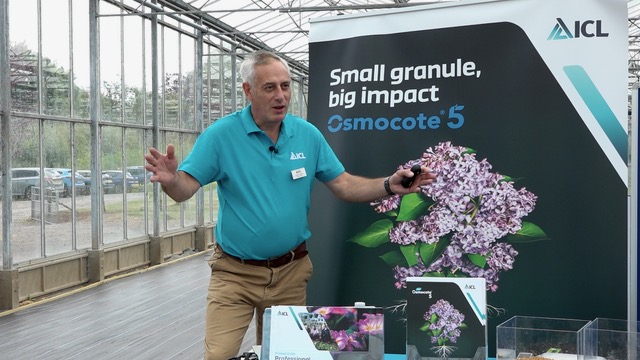
As you plan for the season ahead, it’s worth looking at your fertiliser strategy with ROI in mind. A programme that matches crop cycles can reduce input costs, simplify management and help crops reach market on schedule.
Controlled release fertilisers (CRFs) offer a predictable supply of nutrients over the crop cycle, reducing stress and supporting uniform growth and strong roots. That consistency can make a real difference when aiming for reliable, market-ready stock.

How CRFs work
High-quality CRFs release nutrients gradually, responding to temperature and moisture. Unlike conventional feeding, this approach provides steady growth throughout production, helping maintain plant quality and predictability.
Osmocote CRFs from ICL have been used in the UK for decades. They support uniform growth, strong roots, and improved plant finish, while helping nurseries manage labour and reduce reliance on liquid feeds.
Questioning 12–14 month products
Many growers still use 12-14 month CRFs to cover spring potting and potential overwintering. In cooler UK conditions, this can actually extend release to 14-16 months. Using tools such as AngelaWeb™ 3.0, analysis shows that shorter longevity products – 8-9 months for container stock, for example – can often be sufficient, even for extended cycles.
Matching fertiliser to production
Ornamentals production has changed. Nurseries are often producing smaller, staggered batches to meet defined retail windows. This makes

it important to match fertiliser longevity to the actual growing period, rather than defaulting to long-term products. Plants that perform well for consumers support repeat sales and smoother turnover.
Shorter longevity products can also reduce total inputs without affecting quality. They often bring crops to market sooner, with products such as Osmocote 5 supporting faster growth in peat-reduced and peat-free media.
Planning ahead
A structured review with an ICL technical area sales manager can help fine-tune your fertiliser programme. Using past performance data and tools such as AngelaWeb™ 3.0, programmes can be tailored to specific crops, media and production goals.
ICL is also preparing for upcoming EU regulations on biodegradable coatings, with the launch of N Boost, the first biodegradable CRF, ahead of 2028.